
Herbert Weyl
Herbert Weyl, born in 1923 in Wiesbaden / died in 1998 in Dreieich near Frankfurt.
Herbert Weyl was a German painter, sculptor, and architect. Beginning in 1938, he studied painting at the Wiesbaden Art School as well as architecture in Wiesbaden and Berlin. During the Second World War, he was stationed in Norway and Russia and completed his studies in the late 1940s.
An important mentor was the architect and painter Edmund Fabry, who recognized and supported Weyl’s drawing talent at an early stage. As a young artist, Weyl came into contact with works by Jawlensky, Klee, and Kokoschka, which had a lasting influence on him.
Show More
After the war, Weyl worked as a freelance architect and artist. He had been a member of the Einbeck Painting Circle since 1945 and won prestigious architecture awards during the 1950s. His building projects—including residential and ecclesiastical structures—were realized in Germany, France, and Italy. He received support for these endeavors from, among others, Countess Treuberg (Thurn und Taxis).
A longer stay in Italy in 1957 (including in Turin) brought him a commission in a monastery, which he declined for religious reasons, as he refused to convert to Catholicism. This led to both creative and financial setbacks.
In the 1960s and 1970s, Weyl deepened his exchange with Ernst Fuchs and the Vienna School of Fantastic Realism. Inspired by their ideas, he developed his own style positioned between Surrealism, Symbolism, and expressive painting. During this period, he created significant works with biblical and Old Testament themes, in which landscape, architecture, and spirituality merge.
From 1971 to 1974, he exhibited multiple times at Christa Moering’s gallery in Wiesbaden. Weyl’s preferred medium was oil paint, which he applied in dense, color-intense layers. His works combine spiritual depth with architectural structure and do not follow any contemporary fashion. He rejected overt symbolism and created paintings that reveal themselves to the viewer both immediately and through deeper engagement.
Herbert Weyl is regarded as an important representative of spiritually influenced Surrealism in post-war German art. His works show strong references to Judeo-Christian themes and are distinguished by an independent, timeless style.
He was listed, among others, in Who’s Who in the Arts and the International Directory of Arts.

Painting
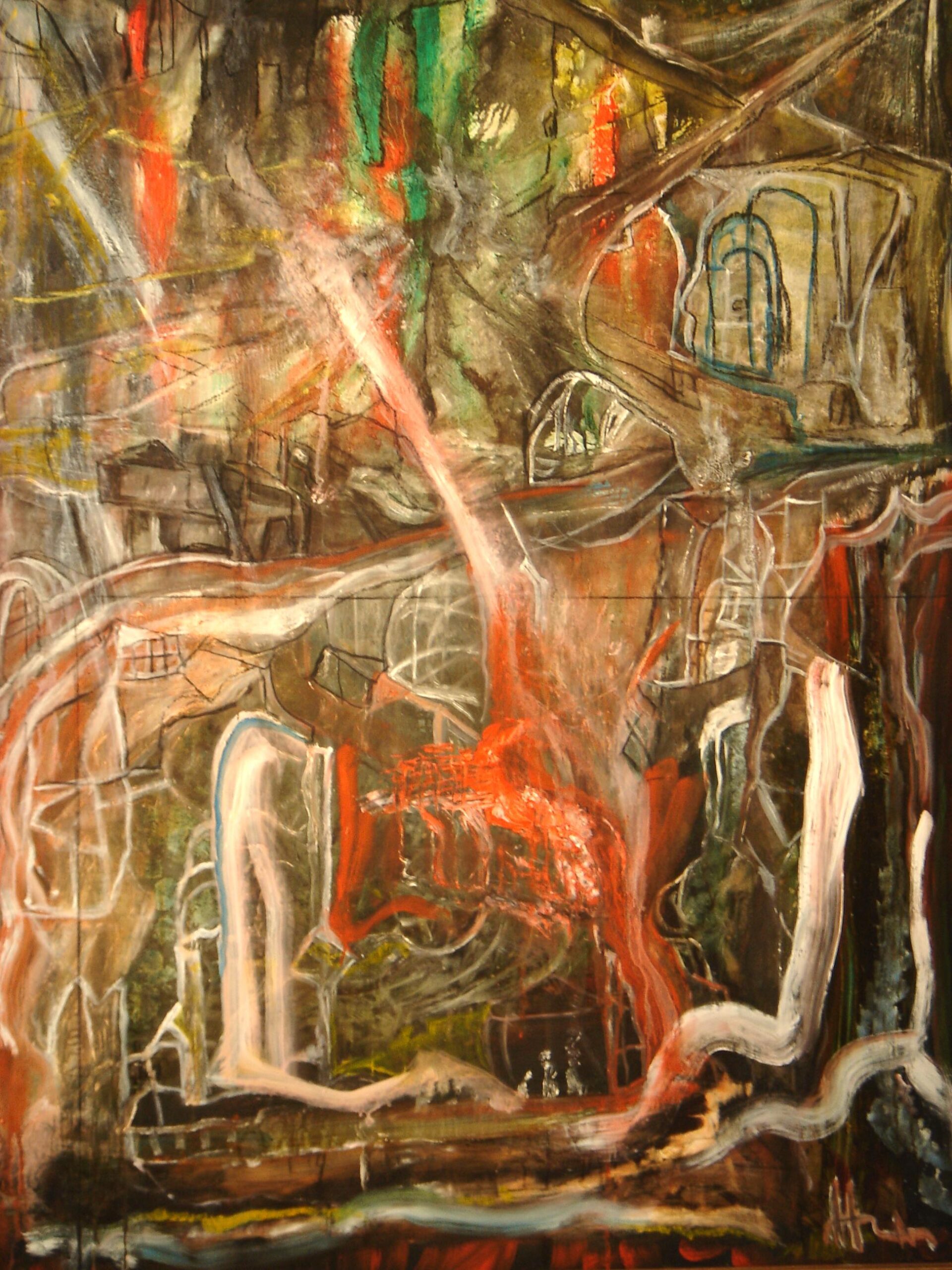
Kognitiv II.

Einblicke

Ohne Titel

Architektur ist Kunst

Phantastische Landschaft
