
Edgar Ehses
Edgar Ehses, born May 23, 1894, in Trier; died January 13, 1964, in Wiesbaden
Edgar Ehses (born May 23, 1894, in Trier; died January 13, 1964, in Wiesbaden) came from an upper-middle-class family. His schooling in Trier and Belgium, early travels to Italy, and an extended stay in London shaped him culturally and artistically. After World War I, which he survived as a front-line soldier, he began an artistic education in 1919 at the Trier School of Applied Arts with August Trümper, and later at the Düsseldorf Art Academy.
Show More
In the 1920s, Ehses lived in Berlin and Paris, where he was inspired by, among others, Braque, Gris, and Modigliani. Friendships with Eduard Bargheer, Werner Gilles, and Fritz Mühsam accompanied him artistically. He lived temporarily in Paris with his wife, fashion designer Martha Stang. He survived the Nazi era by creating fashion designs, and later as a customs officer. Most of his early work was destroyed during the war.
After 1945, he achieved his breakthrough with exhibitions in Baden-Baden, Berlin, and other cities. He became a member of the New Berlin Group, the Palatinate and Darmstadt Secession. He formed friendships with artists such as Karl Hofer, Karl Schmidt-Rottluff, and Otto Ritschl.
Ehses’ style evolved from his early naturalistic work towards figurative abstraction and finally to a highly reduced, symbolic late phase. Particularly influential were his trips to Ibiza (1957, 1959), which led him away from the figurative. His later works – especially in ink – display a meditative, musically rhythmic visual language, which he himself described as “small chamber music”.
In 1963, a major retrospective took place in Trier. Edgar Ehses died on January 13, 1964, in Wiesbaden. His work is considered powerful, continuous, and marked by a clear artistic signature.

Painting & Drawing

Vegetation Ibiza

Abstrakte Stadt

Formen II.

Abstraktion in schwarz

Ohne Titel (Abstraktion in Blau)
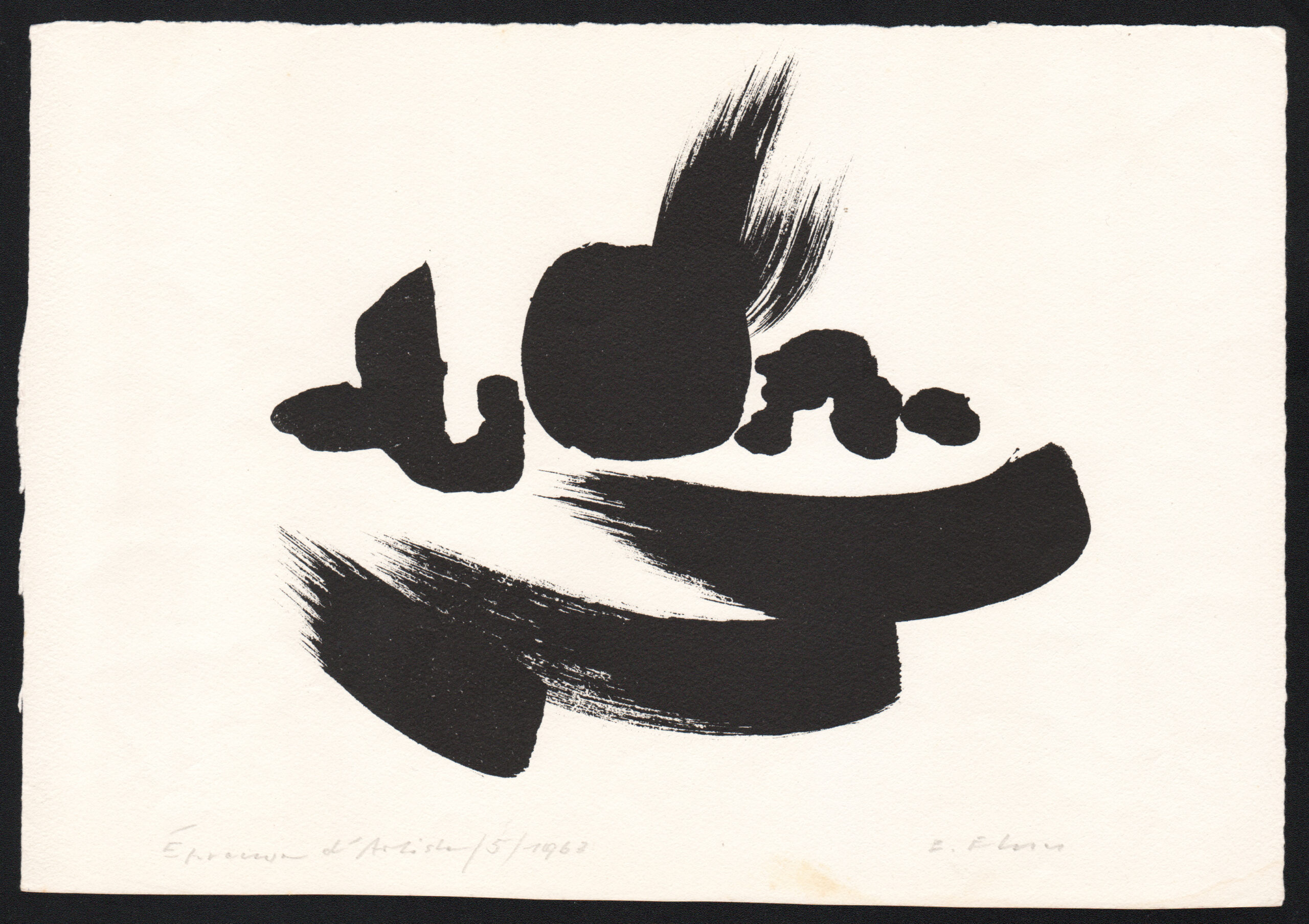
Ohne Titel

Frau (liegend)

Ohne Titel (Abstrakt)
